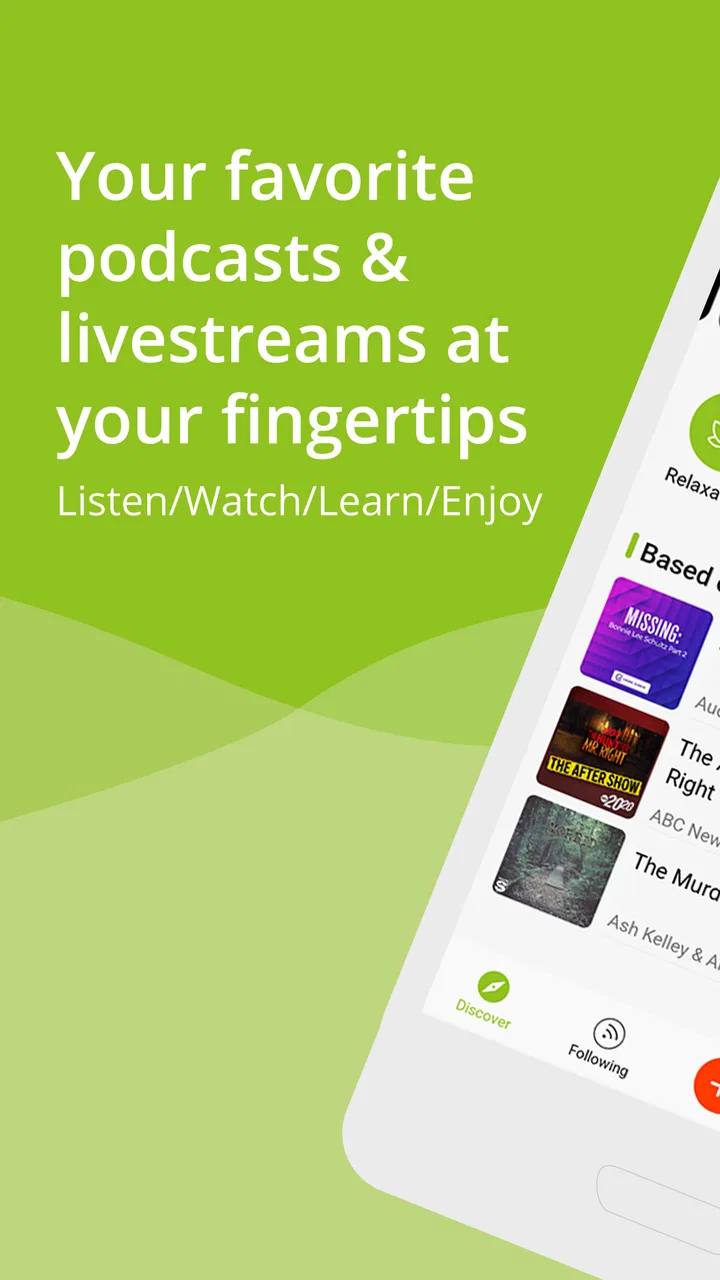
Podcast Player App - Podbean
- 4.6
- Rating
- 10.00M
- Installs
- Free
- Price

 Analysis by App-foxy
I opened Podcast Player App - Podbean with a simple problem in mind: I wanted one place to discover spoken audio, follow shows, and listen without turning podcast time into another chore. After using it as a music and audio app, I found that its strongest quality is not one flashy function. It is the way it connects discovery, playback, livestream listening, and everyday routines in a single workflow.
That makes it appealing if you regularly move between popular podcasts, smaller shows, and live audio. It is also free to start, which lowers the barrier for casual listeners. At the same time, I would not recommend it automatically to everyone. People who already have a carefully organized podcast library, demand the cleanest possible interface, or want every useful feature without optional spending may prefer a different player.
From an empty queue to a listening routine
My starting point was the same as many new users: no carefully prepared library and no desire to spend an evening configuring an audio app. Podbean is published by Podbean - Podcast & Radio & Audiobook, and its focus is broad enough to cover podcasts and livestreams rather than treating the app as only a basic episode player. That wider scope shapes the whole experience.
You May Also Like

 Blood Strike: 2.5 Anniversary
Blood Strike’s Loadouts Turn Every Drop Into a Tactical Gamble
A close look at Blood Strike’s custom loadouts: how fast access to signature weapons reshapes its battle royale rhythm, rewards preparation, and narrows the gap between fights.

 Pandora - Music & Podcasts
Pandora’s Music Is Easy to Start, but Harder to Recover
Pandora’s strength is its low-effort path from a seed to a station. Its weak spot is how much confidence it asks you to place in connection, setup, and quiet recovery.

 8 Ball Pool
 Is Built on Rivalries, Rematches, and Routine
A close look at the rivalries, rematches, shared routines, and unanswered safety questions that turn a quick pool match into a persistent mobile community.

 Samsung Music
’s Quiet Strength Is Playing What You Already Own
Its reach comes less from spectacle than from dependable access to a personal library. That simplicity is both the app’s strongest retention engine and its ceiling.

 AccuWeather: Weather Radar
AccuWeather Review: A Quick, Clear Forecast for Everyday Decisions
For everyday plans, the best forecast is the one you can understand quickly. AccuWeather makes rain timing, radar, and local conditions easy to act on, with a few trade-offs.

 Hill Climb Racing
Why Hill Climb Racing Still Turns Crashes Into One More Run
A tiny car, a bumpy hill and one more upgrade: Hill Climb Racing keeps resurfacing because its simple chaos makes every near-miss feel personal.
More From Our News Desk



The app has been available since July 21, 2015, so it does not feel like a new experiment in the category. Its current version is 9.9.3, and it runs on operating systems from version 11 onward. That compatibility requirement is worth checking before installing, especially if you are using an older phone or tablet. On supported devices, the installation path is straightforward because the app itself is free, although optional purchases range from under a dollar to almost a hundred dollars per item.
When I first approached it, I did not begin by building a perfect subscription list. I looked for something I already knew, then used that starting point to judge how naturally the app moved me toward other listening. This is an important distinction: Podbean works best when you treat it as both a podcast discovery app and a player, not merely as a folder for shows you have already chosen elsewhere.
The catalog-style approach can be useful when you have a vague intention such as “I want something about technology for my commute” rather than a precise episode in mind. It reduces the need to search the web, compare separate feeds, and return to another app to listen. I still prefer entering a specific show when I know exactly what I want, but the broader route is helpful on days when I want the app to do some of the browsing work.
How I move from discovery to the first episode
My usual flow starts with a quick search or browse, followed by a decision about whether I want a single episode or an ongoing relationship with a show. That decision matters more than it sounds. If I am only curious about one topic, I do not want my library filled with a show I may never revisit. If I find a series I expect to follow, saving it early makes the next listening session much easier.
I then play an episode and pay attention to the handoff between finding content and actually listening. This is where many audio apps become frustrating: the discovery screen may be attractive, but the player feels disconnected. Podbean generally keeps the transition understandable. I can move from choosing content to listening without having to reconstruct what I selected.
For a realistic weekday example, imagine that I leave home with a short window before work. I search for a familiar show, choose an episode that fits my available time, and start listening while walking to the station. Later, I return to the app instead of starting from scratch. That kind of continuity is more valuable to me than a crowded collection of decorative settings because it protects the small pockets of time in which podcasts actually get heard.
I also found a useful trade-off in the way I manage the library. Saving everything feels convenient at first, but it quickly turns the listening area into a backlog. I get better results by keeping only shows I genuinely expect to revisit and using search for one-off listening. This is not a limitation unique to Podbean, but the app encourages enough discovery that careless saving can become a problem faster than expected.
The player is only one part of the handoff
Once playback begins, my attention shifts from finding audio to managing the moment around it. A good podcast player needs to disappear when I am listening, then become easy to control when I am not. Podbean is most comfortable in ordinary situations: starting an episode at home, pausing it before a meeting, and returning later during a commute or household task.
The practical test is not whether the first play button works. It is whether the app supports the small interruptions that define real listening. I often begin an episode while doing something else, stop when another task demands attention, and come back much later. Podbean fits that pattern better than a service designed primarily around continuous music playback, because the content is organized around shows and episodes rather than only an endless stream.
That said, I would not confuse a broad podcast catalog with a perfect personal system. If your main priority is highly granular control over a large private audio collection, a dedicated local media player may be a better handoff point. Podbean makes more sense when the content begins inside its own podcast and audio environment.
The livestream side changes the rhythm again. Recorded episodes let me choose the time and pace of listening, while live audio asks me to join what is happening now. I like having both possibilities available because they serve different moods: an episode is useful for a planned commute, while a livestream can feel more immediate when I want to participate in an ongoing broadcast.
However, live listening is naturally less forgiving. If I miss the beginning or cannot stay connected to the moment, the experience is not as convenient as selecting a recorded episode. I see livestreams as a complementary reason to keep the app installed, not as a replacement for an on-demand podcast routine.
Where Podbean fits beside familiar alternatives
Compared with a minimalist podcast player, Podbean feels more like a destination. A minimalist alternative may be preferable if you already know every show you want and care mostly about a compact subscription list. In that situation, extra discovery and livestream content can feel like noise rather than help.
Compared with a general music streaming service, Podbean is more focused on spoken audio. A music-first service may win when your day moves constantly between songs, albums, and podcasts. Podbean is the better fit when podcasts are the center of your listening and you want the app’s identity to reflect that.
Compared with a platform tied closely to one ecosystem, Podbean can be attractive to someone who does not want the podcast habit to depend on a particular music subscription. The free entry point also makes it easier to test the workflow before deciding whether optional purchases are worthwhile. I would still review any purchase screen carefully rather than assuming every useful part of the experience is included at no cost.
Its public reception suggests that many listeners find the overall approach useful: the app holds a 4.6 average from roughly 216 thousand ratings, with about 29 thousand written reviews. It has also passed 10 million installs. Those figures do not decide whether it suits me, but they do indicate that this is an established choice rather than an obscure player I would install without knowing what to expect.
Three habits that make the experience better
My first practical tip is to separate exploration from commitment. I browse when I am in the mood to discover something, but I only keep a show when I have a clear reason to return. This prevents the library from becoming a second inbox. It also makes the next handoff—from opening the app to choosing an episode—much faster.
My second tip is to choose content according to the next interruption, not only the topic. If I know I have a short walk, I choose a compact episode rather than beginning a long conversation that I will repeatedly pause. When I have uninterrupted time, I can afford to start something longer. Podbean becomes more useful when I treat episode selection as time management rather than random browsing.
My third insight is to use recorded podcasts and livestreams for different purposes. I use recorded episodes when I need predictable control, and I reserve live audio for moments when immediacy matters more than convenience. Mixing those expectations can make the app seem inconsistent, while recognizing the difference makes the broader audio offering feel intentional.
A fourth habit is to keep the app’s purchase model in mind before building a routine around optional extras. The free version is enough to evaluate whether discovery and playback suit me, but in-app items can cost from $0.99 to $99.99 each. I would not spend simply because a feature appears; I would first use the basic workflow for several listening sessions and decide whether the added value addresses a real problem.
Who will enjoy it, and who should skip it
I think Podbean is a strong match for a listener who wants to discover podcasts without juggling several services. It is especially suitable for someone who alternates between familiar shows and new topics, listens in short daily sessions, and likes having livestreams nearby even if they are not used every day.
It is also a sensible starting point for a person who has never settled on a podcast app. The free download removes much of the risk, and the Teen content rating makes the intended audience clear enough for families and younger users to consider the app with appropriate attention to the shows they choose. The rating applies to the app’s content classification, not a guarantee that every individual podcast will suit every listener.
I would suggest looking elsewhere if you want an extremely stripped-down interface with almost no discovery layer. I would also hesitate to recommend it to someone whose priority is managing a large collection of downloaded personal audio files, because a podcast-centered service is not necessarily the best tool for that job. Likewise, if you strongly dislike optional purchase prompts or want a completely uniform free experience, the in-app purchase range deserves consideration before you commit.
Another possible mismatch is the listener who wants music and podcasts blended into one seamless daily queue. Podbean belongs more naturally to the spoken-audio side of the phone. It can replace a podcast app, but it is not the obvious replacement for a full music service.
The points where my workflow breaks
The first friction point is choice overload. Discovery is useful until I open the app without a plan and start browsing indefinitely. The more categories and possibilities I consider, the less likely I am to begin listening. My solution is simple: search for one subject, choose one episode, and leave the rest for another session.
The second break occurs when a livestream does not match my schedule. Live audio cannot offer the same flexibility as an on-demand episode, so I would not build a routine that depends entirely on catching broadcasts at the right moment. Podbean’s wider range is a benefit, but it also means I need to choose the right content type for the day.
The third is the difference between free access and optional spending. A free app is easy to try, but the presence of purchases means I should not assume that every enhancement belongs to the basic experience. I prefer to make that decision after I understand my actual listening needs rather than treating an optional item as necessary at installation.
There is also the ordinary compatibility checkpoint. Because the minimum operating system is version 11, anyone using older hardware should verify that the device can run it before planning a migration from another player. For supported phones, this is a minor step; for an older device, it can be the deciding factor.
My outcome after using it as a daily audio tool
After following the complete path—from an empty starting point, through discovery, episode selection, playback, interruption, and return—I see Podbean as a practical all-rounder rather than a specialist tool. Its value comes from reducing the number of separate decisions required to get from “I want something to listen to” to actual spoken audio.
I especially like the way it accommodates two different listening intentions. I can plan with recorded podcasts, then switch to a livestream when I want something more immediate. That handoff gives the app more range than a basic feed reader, while still keeping podcasts at the center of the experience.
My recommendation is therefore conditional but positive. Try it if you want a free entry into a large podcast-and-audio environment, enjoy discovering shows, and need an app that works for both planned and spontaneous listening. Give it a pass if you already have a perfectly organized minimal player, want a music-first home, or dislike evaluating optional purchases.
For me, the best result is not that Podbean makes every listening decision for me. It gives me enough discovery and structure to start quickly, then leaves me in control of what becomes part of my routine. The app is at its best when it turns scattered listening time into a repeatable workflow: find something suitable, play it, pause when life interrupts, and return without rebuilding the whole plan.
FAQs for Podcast Player App - Podbean
01What is Podbean, and what can I do with the app?
Podbean is a podcast listening and publishing platform for Android and iOS. After installing it, you can search for shows by name, topic, or category, subscribe to podcasts, stream episodes, and download them for offline listening. The app also includes listening history, playlists, recommendations, and access to live audio content, depending on the shows and features available in your region.
02Can I listen to podcasts offline with Podbean?
Yes. Podbean lets you download podcast episodes while connected to Wi-Fi or mobile data, so you can listen without an internet connection later. This is useful for flights, commuting, or areas with weak coverage. Before downloading, check the app’s storage settings and make sure the episode has finished downloading; streaming and downloading may also use mobile data if Wi-Fi is unavailable.
03Is Podbean free to use, or does it require a subscription?
Podbean offers a free version that provides access to many podcasts and basic listening tools, although the experience may include advertising or feature limitations. Some podcasts, premium episodes, or advanced services may require payment, depending on the creator’s settings. Review the pricing information shown in the app before subscribing, especially because billing and renewal are handled through the relevant app store.
04Can I create and publish my own podcast using Podbean?
Yes. Podbean is not only a podcast player; it also provides tools for creators who want to record, upload, manage, and distribute podcast episodes. Depending on the plan and device, you may be able to record directly, add episode details, view audience statistics, and manage your show from the platform. Storage, monetization, and advanced analytics can vary by account type.
05Does Podbean work well on both Android and iPhone?
Podbean is available for both Android and iOS, and its main listening features are offered on both platforms. You can browse shows, subscribe, stream episodes, and manage downloads from a compatible phone or tablet. The exact interface, permissions, notification behavior, and some creator tools may differ slightly between operating systems, so keep the app updated for the most reliable performance.
Pros
- Large podcast catalog with shows across many genres and languages.
- Offline downloads let you listen without using mobile data.
- Playback speed controls are useful for fitting episodes into busy schedules.
- Personalized recommendations make discovering new podcasts easier.
- Supports live audio
- allowing access to broadcasts and interactive shows.
Cons
- Some advanced features and content require a paid subscription.
- The app may display frequent promotional banners and upgrade prompts.
- Audio quality and episode availability can vary between podcast publishers.
- Large catalogs and recommendations can feel cluttered for new users.
- Background playback and downloads may increase battery and storage usage.

Podcast Player App - Podbean
Gallery